Pentecost is, at its core, the celebration of the Church’s birth, rooted in ancient harvest festivals. To grasp its importance, we need to understand its Jewish context in Shavuot—the giving of the Torah—and its Christian context in the Descent of the Holy Spirit. Both traditions celebrate it 50 days after Easter, symbolizing the transition into the warm season, from the end of the barley harvest to the beginning of the wheat harvest. For Jews, it’s also a memorial day for receiving the Torah on Mount Sinai; for Christians, it marks the Church’s founding.
To better understand Pentecost, let’s begin by exploring its Jewish roots:
Shavuot is a major Jewish festival. It’s held fifty days after Passover (Pessach), which is not equivalent to Easter but very closely related to it. During Shavuot, Jews don’t work. Instead, they decorate homes with greenery, synagogues with flowers, listen to the reading of the Ten Commandments, enjoy dairy foods (which symbolize sweetness and richness of the Torah), throw candle-lit dinners, and stay up all night to study Torah. In Israel, it’s a one-day holiday, but in the diaspora, a two-day holiday, which takes place between 15th May and 15th June. Reading the Book of Ruth (which takes place during the barley harvest) is another traditional part of Shavuot.
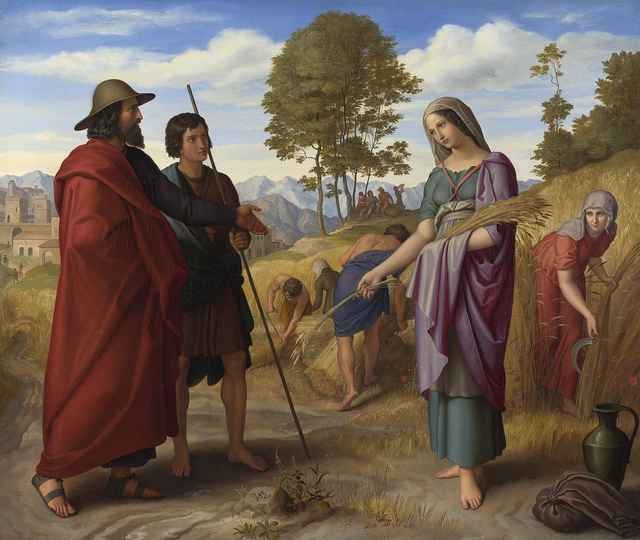
Ruth, Bible, Julius Schnorr von Carolsfeld
So what is the Jewish meaning of Pentecost? It’s a memorial day of the giving of Torah, when God proclaimed the Israelites as a holy nation. The gift of the Holy Spirit and Torah happened during Shavuot, which was in ancient times also related to pilgrimages.
Now let’s shift from Shavuot to the Christian perspective on Pentecost:
Pentecost is a major Christian festival in several Christian Churches, second only to Easter. Sometimes, it’s also called Whitsun or Whit Sunday. The name comes from the Greek word ‘pentecoste’, meaning ‘the fiftieth’. According to the Bible, Mary, all the apostles, and numerous followers from all parts of the Roman Empire gathered in Jerusalem, seven weeks after Jesus’ resurrection. Suddenly, they felt a strong wind, and a flame appeared on each one of them. The wind and the flame were manifestations of the Holy Spirit. The Holy Spirit is the third part of the Holy Trinity (Father, Son, Holy Spirit).

Pentecost, Velazquez
The apostles started speaking in different languages, so people of numerous nationalities started understanding them. We can say that the act was somehow the reversal of the happening in Babylon. On that day, several thousand people were baptized. Apostolical Pentecostals’ meaning is therefore a celebration of these happenings.
The Relationship between Shavuot and Pentecost
Pentecost evolved from Shavuot. It adopted the time of celebration but gradually emphasized the role of the Holy Spirit. Like all Christian holidays, it drew its essence from old festivals, traditions, and customs, bringing the feast closer to various people of different backgrounds. While Jewish holidays are always somehow exclusive and often require certain prior knowledge to participate, Christian holidays are much easier to accept and enjoy.
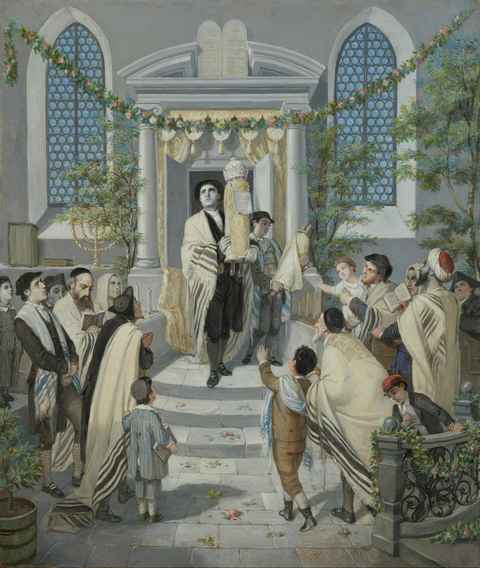
Shavuot by Moritz Daniel Oppenheim
Pentecost is no exception. A variety of Christian churches and fine-tuning to local tradition inevitably result in numerous different celebrations of Pentecost around the world. Still, one characteristic is in common to all of them: greenery and flowers!
Now that we’ve examined the backgrounds and relationships between Shavuot and Pentecost, it’s important to understand when Pentecost is celebrated:
As a movable holiday, it’s celebrated on different dates every year. It always falls in May or June. Thanks to different calendars used by Western and Eastern churches and different dates of Easter, each year brings us two dates for the celebration of Pentecost. Well, not every year. In some years, both celebrations fall on the same date. This is a table for Pentecost Holidays from 2025 to 2045:

Pentecost Traditions
While the Catholic Church treats Pentecost as a one-day holiday, Eastern Orthodox Christianity often refers to all fifty days from Easter to Pentecost Sunday as Pentecost. Commemorations can be quite different, as seen on White Monday, the day after White Sunday (another name for Pentecost Sunday). In several countries, it’s a public holiday, when banks and most public services are closed; in others, it’s a normal workday.
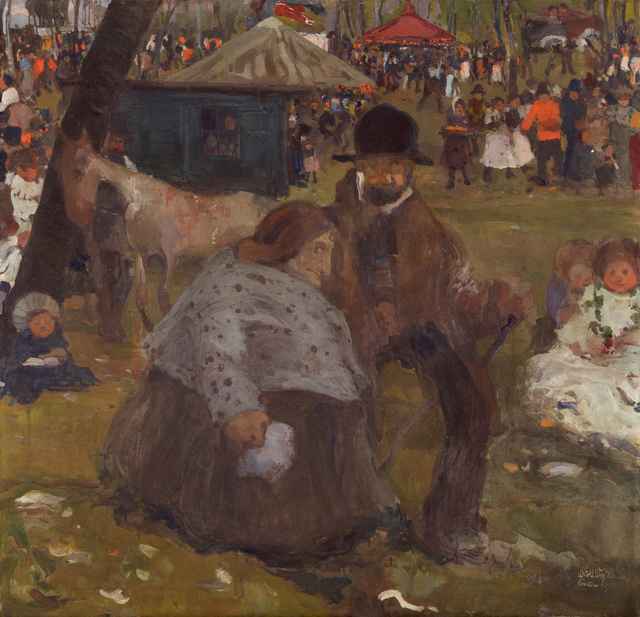
Pentecost Holiday Fair Near Cracow, Witold Wojtkiewicz
Why is White Sunday called White Sunday? Everybody familiar with the traditions of this feast probably acknowledges white garments worn by catechumens, expecting to be baptized on this day. There’s also a tradition of young women of the parish coming to the masses in new white dresses, and church and chapel parades still organize so-called white walks on this day. But the origin of the name very likely comes from the belief that the Holy Spirit brought wit and wisdom to people on Pentecost. Not much language juggling was needed to rename Wit Sunday to Whit Sunday and finally White Sunday.
But let’s return to Pentecost. Around the world, numerous outdoor activities take place: processions, baptisms, confirmations, and festivals, many organized by youth organizations. Pentecost is a celebration of spring, vitality, and community, with family meals and public readings from holy books. Wearing red, symbolizing the tongues of fire and the Holy Spirit, is a strong tradition among clergy and congregation members alike.
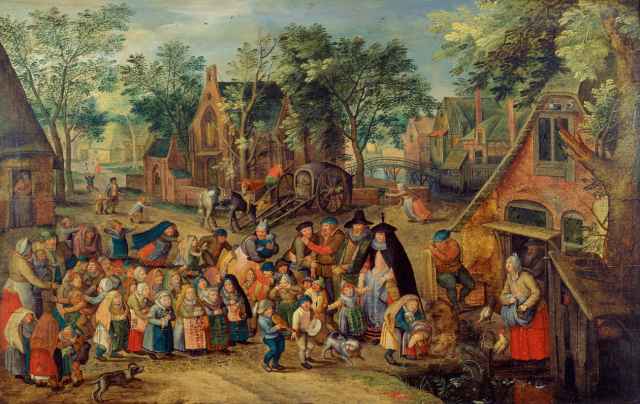
The Pentecost Bride Game, Pieter Brueghel, the Younger
Another important color is green, which can also be worn in churches (it’s the liturgical color for Pentecost in Eastern Orthodox Christianity) during masses. Green represents new life, growth, and spiritual renewal. For the same reason, churches and homes are decorated with flowers, grass, and branches. Greenery is always associated with natural cycles and eternal life. Colors and greenery may vary from location to location for purely practical reasons. The preferred plant is the one that is available. Some of the favorites are birch, mint, oak, and grass.
Pentecost Celebrations Around the World
While we can’t assign a specific celebration to each country or church, there are certain events and traditions that are characteristic of a region or part of the world. We compiled them and sorted them by country in alphabetical order:

Pentecost, Albrecht Duerer
England
Whitsun in England is still partly related to old pagan rites, as Morris Dancing and drinking Whitsun ale to celebrate the beginning of summer. Pentecost, with the following week, is one of the three major festive weeks (with Easter and Christmas) when whole communities celebrate. For some time, Morris dance, a representation of community, fertility, and rebirth, lost its popularity, but in recent years it’s back, although in certain variations.
Germany
On Pentecost, birch branches and cowbells are everywhere. They are used to decorate homes, taverns, churches, and even fountains. Sundays are traditionally reserved for picnics and Mondays for processions. The most famous procession is the Whitsun Ride in the Bavarian forest. Several hundred festively decorated horses and horsemen (all men) commemorate a journey of the priest on this holy day in the 15th century to give a last blessing to a dying man.

The procession of the knights of the Order of the Holy Spirit, Adrien Emmanuel Marie
Hungary
Csiksomlyo pilgrimage is the major Pentecost-related event in Hungary. Several tens os thousands of pilgrims travel to Csiksomlyo, a village in Transylvania, Romania, to pray at the statue of the Blessed Virgin Mary.
Italy
Pascha Rosatum (The Feast of the Roses) is an Italian way to celebrate Pentecost Sunday. Rose petals are scattered from the ceilings of the churches in memory of flames appearing on Mary and the apostles. Veni Creator Spiritus is sung at the end of the liturgy.
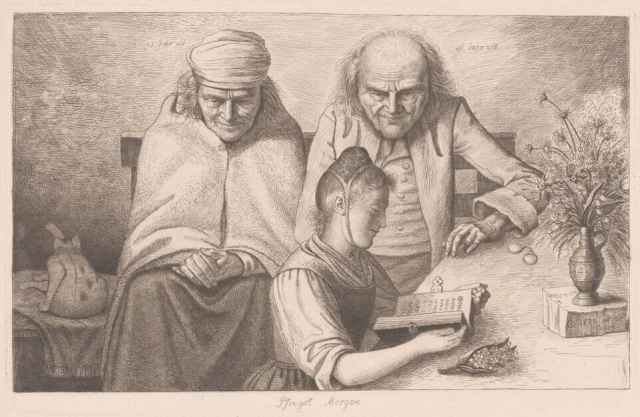
Pfingsten Morgen (Pentecost Morning), Ludwig Emil Grimm
Norway
Pentecost is another reason to return to nature in Norway, where masses put on hiking equipment and go to Bergen. Long hikes are a great way to destress from everyday life, inner contemplation, or deep conversations with relatives.
Poland
Birches and other greenery are used to decorate buildings, and even the cattle. Decorating cattle led to an expression for an overdressed person to be ‘dressed like a Whitsun ox.’ Carved doves in churches holding special services represent the Holy Spirit. In some parts, processions to fields, where they bless crops, are held. An old pagan tradition of children hunting a young man dressed in moss and leaves, called hunting a green man, is still alive in some rural parts.
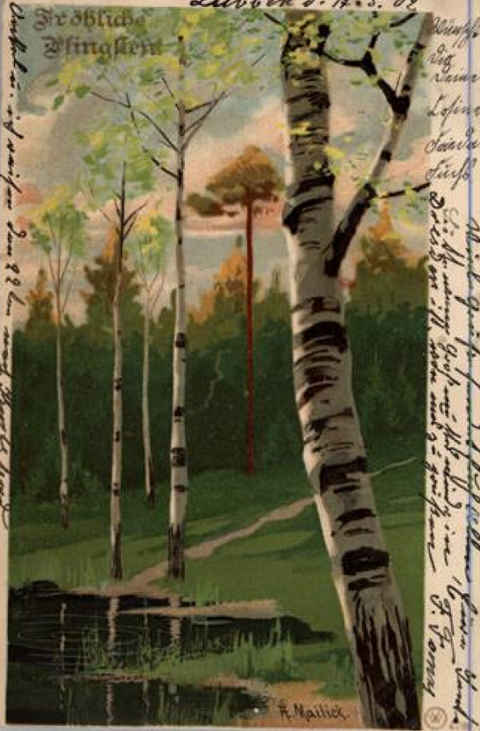
Pentecost Greeting Card, Alfred Mailick
Russia
Trinity Sunday, or Troitsa, as they call Pentecost in Russia, is closely related to Mary and is generally considered a women’s holiday. On this day, churches are richly decorated with flowers and greenery, including birch branches, and girls wear flower crowns and woven birch twigs. Birches are often decorated with ribbons and flowers. A traditional meal served on Pentecost is fried eggs.
Spain
While Pentecost is not a public holiday, a huge pilgrimage with close to one million pilgrims traveling to Almonte, Andalucia, is one of the most important events in Europe. This procession has several centuries of tradition, being held since the mid-seventeenth century when the Virgin of Las Rocinas was proclaimed as a patron saint of Almonte. Pilgrims are often dressed in traditional attire.